

 English
 Español
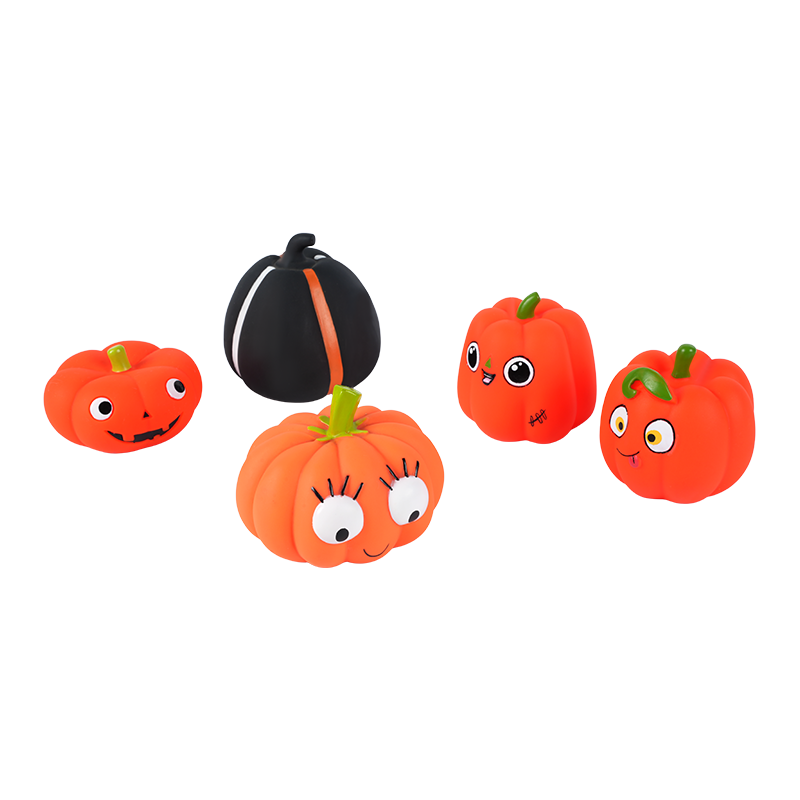
A pumpkin-shaped squeaky toy sells in October. It gets chewed in November. If it falls apart by December, the owner remembers which brand failed. A pumpkin squeaky dog toy factory builds a holiday toy that has to meet the same durability standard as an everyday chew while hitting a seasonal price and a tight production window. The shape sells it. The squeaker and the stitching keep the customer.
The Squeaker Has to Outlast the Holiday
A squeaker that goes silent on the first day turns the toy into a stuffed pumpkin. The dog loses interest. The owner feels cheated. The factory seats a reed-style squeaker inside a plastic housing and anchors it in a reinforced fabric pocket. The dog cannot work it loose from the outside.
The squeaker size has to match the toy body. A large pumpkin with a tiny squeaker sounds weak. A small pumpkin with an oversized squeaker bulges and creates a pressure point where the fabric wears first. The factory that tests the tone and the volume in the finished toy ships a product that squeaks until the toy itself gives out.
Double Stitching, Because the Dog Does Not Know It Is Seasonal
Plush toys live in a contradiction. Soft enough to carry, tough enough to survive shredding. The factory builds the pumpkin in layers. Soft plush on the outside for the look. A reinforced mesh underneath for the tear resistance. When the plush gives way, the mesh holds the stuffing.
The seam is where many plush toys fail. Single stitching pulls apart under chewing. Double stitching with nylon thread holds. The stuffing goes into a separate inner bag so that even when the outer fabric tears, the fill stays inside the toy instead of spreading across the living room floor.
Faces Embroidered, Not Glued
The pumpkin has to read as a pumpkin. The ridges, the stem, the face if it is a jack-o'-lantern. Every attached piece is a chew point and a choking hazard. The factory embroiders the features directly into the fabric rather than gluing on plastic eyes or a fabric stem that a dog can bite off.
The colorfastness matters on an orange toy. A pumpkin that fades or bleeds dye when it gets wet looks old before the season ends. The factory that uses colorfast dyes and plush that resists dirt keeps the toy looking fresh through Halloween and beyond.
Here is what a pumpkin squeaky dog toy factory has to deliver:
- Reed squeaker anchored in a reinforced pocket
- Double-stitched seams with nylon thread
- Stuffing contained in a separate inner bag
- Embroidered features instead of glued attachments
- Colorfast dyes that hold through washing
- Sizing matched to the dog breed
Why the Seasonal Window Is Tight
Seasonal products ship early and do not get reordered if they sell out. The factory that hits the mid-year production window gets the toy on the shelf before the Halloween rush. Late delivery means markdowns and missed sales.
The pumpkin is a gift item as much as a dog toy. It goes into a Halloween basket or a fall photo. The owner posts the picture. The toy has to look good in the photo and survive the chew that follows.
The Toy That Fails by Thanksgiving
A cheap pumpkin toy loses the squeak in a week, sheds stuffing by the middle of the month, and the stem comes off in the dog's mouth. The owner does not buy that brand again. The factory that reinforces the seams, anchors the squeaker, and builds the features into the fabric ships a toy that lasts past the holiday and into the next season.
A pumpkin squeaky dog toy is simple. Fabric, stitching, a squeaker, and a shape. The combination has to hold up to a dog that does not know the toy was meant for October.


 +86-13777516794
 Pudong Urban Industrial Functional Zoning of Baima Town, Pujiang, Zhejiang, China